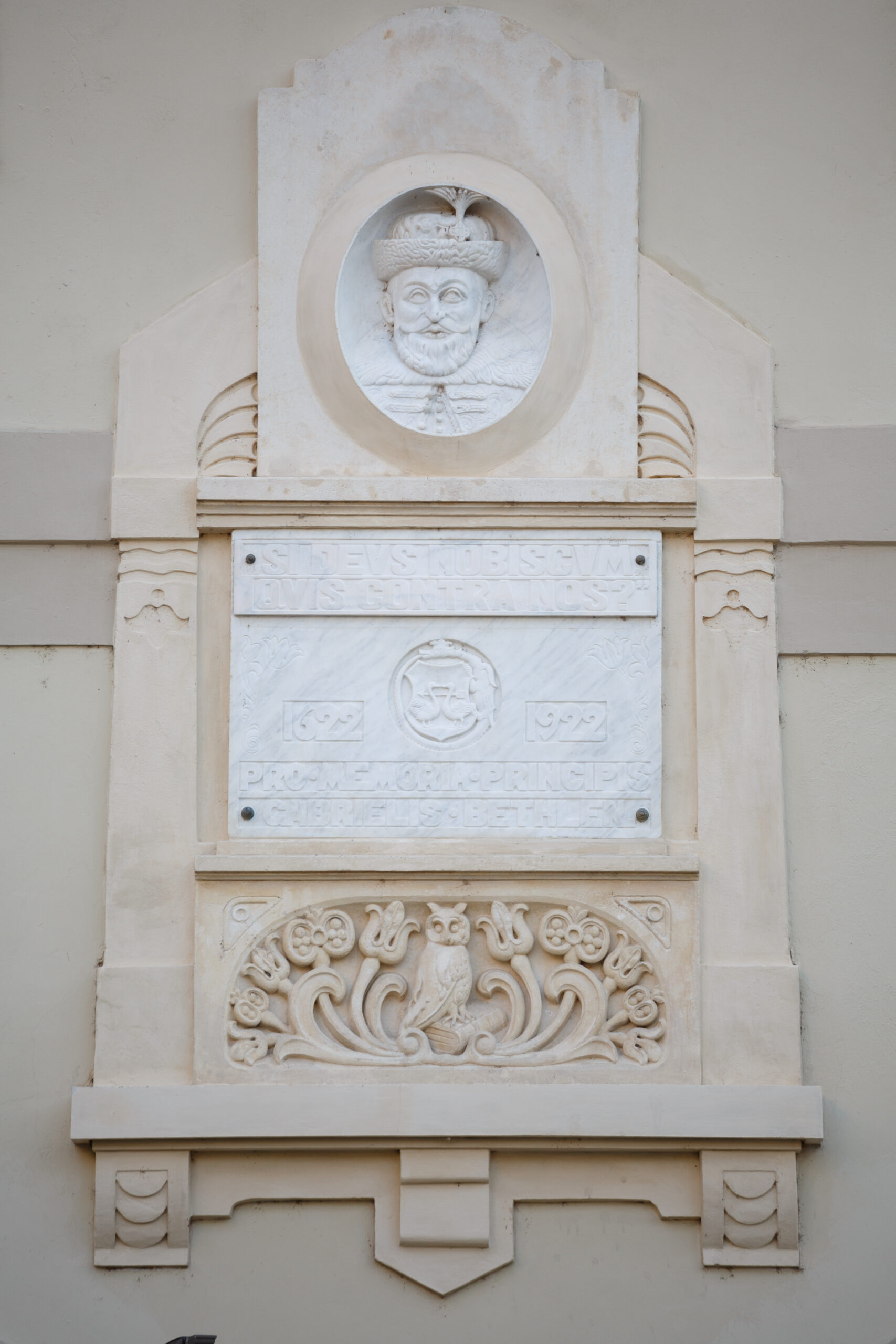
Founder
Bethlen Gábor

BGK

Who was Gabriel Bethlen?

Gabriel Bethlen was one of the most important figures in 17th-century Hungarian history.

At the beginning of his career, Gabriel Bethlen loyally served Zsigmond Báthory, Moise Székely, István Bocskai, and Gábor Báthory. However, when the latter sought an alliance with the Habsburgs, Bethlen opposed it and was elected prince in his place. During his reign, he strengthened Transylvania’s position, and the country’s economy and cultural life experienced a period of prosperity—this era is often referred to as the “Golden Age of Transylvania.”

Are you curious?

Get to know him better.

Gabriel Bethlen’s ancestors, the Neczpáli family, owned estates in the counties of Békés and Zaránd. It is believed that the Bethlen family took its name from the village of Iktár in Temes County, which they likely acquired in the 14th century. Gabriel Bethlen’s grandfather, who bore the same name, led six hundred lancers at the Battle of Mohács and, following the defeat and internal conflicts, supported John Zápolya against Ferdinand. His father, Farkas Bethlen, initially a supporter of Ferdinand, distinguished himself in battles against the Turks, then, at the call of John Sigismund, settled in Transylvania, where he became the country’s chief captain. He took part alongside Stephen Báthory, Prince of Transylvania, in the Battle of Kerelőszentpál in 1575, and for his merits received the Marosillye estate in 1576.

Gabriel Bethlen’s mother, Druzsina Lázár, came from a family of Szekler nobility from Gyergyószárhegy. Of the children of Farkas Bethlen and Druzsina Lázár, only Gabriel and his brother István — born in 1584 and later a prince — reached adulthood. The two boys were raised in the Marosillye castle until their father’s death, which occurred in either 1590 or 1592. Although they learned to read and write at home, their upbringing emphasized practical and military skills. Farkas Bethlen had intended to send Gabriel to study at the Jesuit Academy in Cluj, but his premature death prevented this.

After Stephen Báthory confiscated the Marosillye estate from the orphans, their mother moved with her sons to her brother, András Lázár, in Gyergyószárhegy. Following their mother’s death, the boys were raised by András Lázár, who prepared them for a military career and paid little attention to their cultural education. Gabriel Bethlen later recalled that they had not been taught Latin, a skill he managed to acquire partially on his own.

The court at Alba Iulia developed him into a political and cultural center, and here, in 1622, he founded a Reformed college. He supported the studies abroad of Hungarian students, especially in the Netherlands and England, countries at the forefront of civic development.

Before marrying for the second time, his nephew István Bethlen was designated heir, and his education was arranged accordingly. His wife, Katalin of Brandenburg, to whom the National Assembly at Alba Iulia in May 1626 granted succession rights (together with her brother, István Bethlen), occupied the principality’s throne for only a few weeks after her husband’s death.

A fragment from his final moments before death:
“Although he could hardly speak, he requested a glass, a sheet of paper, and a pen, with which he neatly wrote two orders, then turned away and left them there; those papers, and I myself thinking that perhaps he wanted to leave something in addition to the usual will for his close ones, I placed them on a nearby table, requested to see them; I bowed and left, and when the servant entered and handed him the fan, I read the letter; he seemed to want to rest, so I left as well; the letter contained these words, without writing more and without speaking afterward, the poor man — which is now kept at Rhédei Ferenc, and was to reach after the death of the elder István Bethlen:
‘If God is with us, who can be against us? Surely, there is no one, surely there is no one.'” — Kemény János